EXECUTIVE POWER
Appeal Council
Decree of the President of the Republic of Azerbaijan on the Establishment of Appeals Councils in the Central and Local Executive Authorities of the Republic of Azerbaijan
Model Regulation on the Appeals Councils of Local Executive Authorities
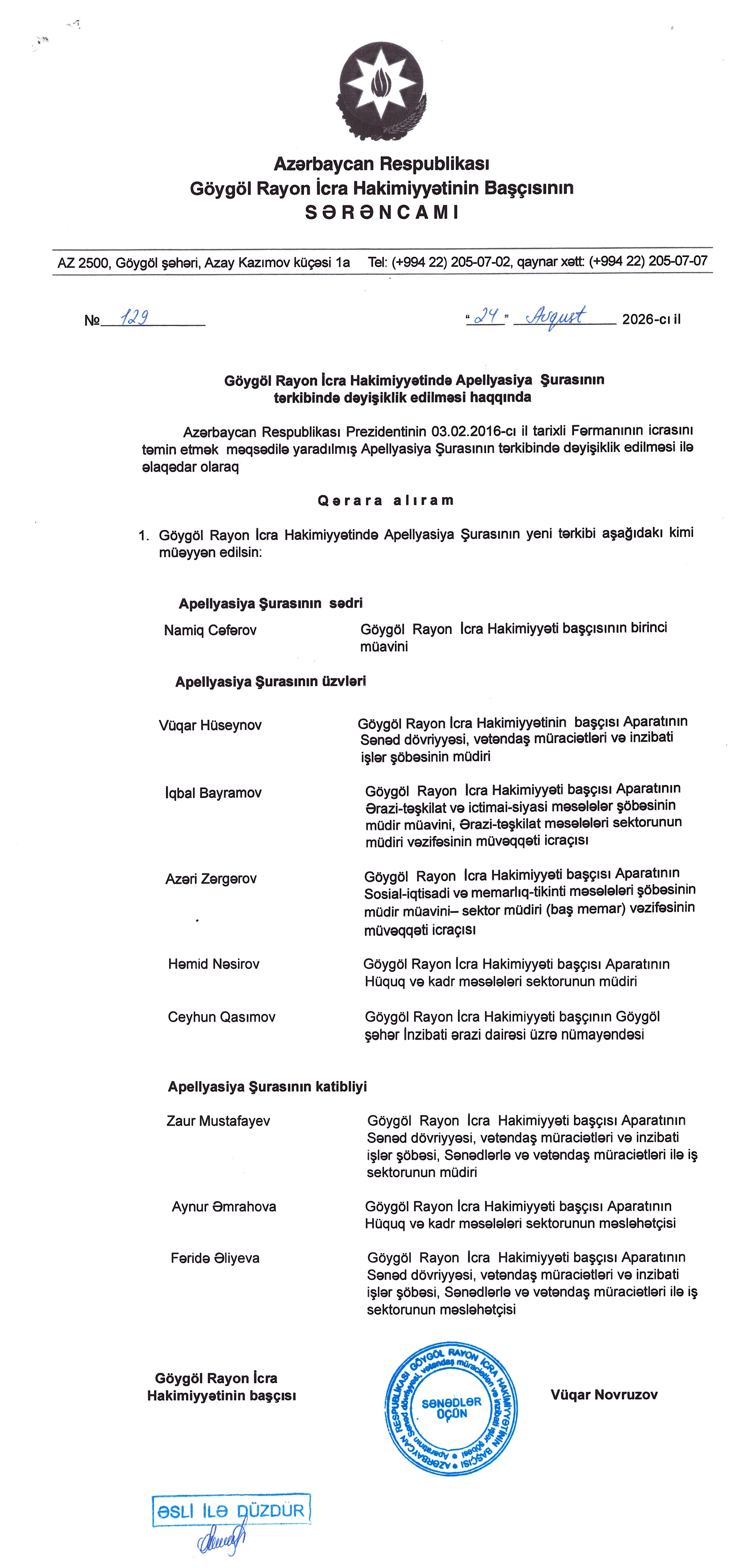
Order of the Head of the Goygol District Executive Authority on the Establishment of the Appeals Council of the Goygol District Executive Authority
Information on the Composition of the Appeals Council Established under the Goygol District Executive Authority
Decree of the President of the Republic of Azerbaijan
on the Establishment of Appeals Councils in the Central and Local Executive Authorities of the Republic of Azerbaijan
Guided by Article 109, paragraph 32 of the Constitution of the Republic of Azerbaijan, and in order to ensure transparency and objectivity in the review of complaints of individuals and legal entities engaged in entrepreneurial activity, as well as to protect their rights and legally protected interests in this field, I hereby decree:
1.Appeals Councils shall be established within the central and local executive authorities of the Republic of Azerbaijan.
2.The “Model Regulation on the Appeals Councils of Central Executive Authorities” shall be approved (attached).
3.The “Model Regulation on the Appeals Councils of Local Executive Authorities” shall be approved (attached).
4.The Cabinet of Ministers of the Republic of Azerbaijan shall:
4.1. Within three months, prepare and submit to the President of the Republic of Azerbaijan proposals on bringing the acts of the President of the Republic of Azerbaijan into conformity with this Decree;
4.2. Within three months, ensure that the normative legal acts of the Cabinet of Ministers of the Republic of Azerbaijan are brought into conformity with this Decree and inform the President of the Republic of Azerbaijan accordingly;
4.3. Exercise control over bringing the normative legal acts of central executive authorities into conformity with this Decree and, within five months, inform the President of the Republic of Azerbaijan about the implementation thereof;
4.4. Resolve other issues arising from this Decree.
5.The Ministry of Justice of the Republic of Azerbaijan shall ensure that the normative legal acts and normative acts of central executive authorities are brought into conformity with this Decree and inform the Cabinet of Ministers of the Republic of Azerbaijan accordingly.
Ilham Aliyev
President of the Republic of Azerbaijan
Baku, 3 February 2016.
Model Regulation on the Appeals Councils of Local Executive Authorities
Approved by the Decree of the President of the Republic of Azerbaijan dated 3 February 2016
1.General Provisions
1.1. The Appeals Council of local executive authorities (hereinafter – the Appeals Council) is a collegial body operating on a public (non-remunerated) basis, which reviews repeated complaints (hereinafter – complaint) submitted by individuals and legal entities engaged in entrepreneurial activity regarding decisions, orders, actions or inaction of a local executive authority related to their entrepreneurial activity (except for applications related to corruption offenses).
1.2. In its activities, the Appeals Council shall be guided by the Constitution of the Republic of Azerbaijan, the Law of the Republic of Azerbaijan “On Administrative Proceedings,” other laws of the Republic of Azerbaijan, decrees and orders of the President of the Republic of Azerbaijan, decisions and orders of the Cabinet of Ministers of the Republic of Azerbaijan, international treaties to which the Republic of Azerbaijan is a party, and this Regulation.
1.3. For the purposes of this Regulation, a “complaint” means a written application submitted to the Appeals Council by individuals or legal entities engaged in entrepreneurial activity regarding decisions, orders, actions or inaction of a local executive authority concerning their entrepreneurial activity.
1.4. In performing its duties and exercising its rights, the Appeals Council shall cooperate with other executive authorities, local self-government bodies, non-governmental organizations, as well as legal entities and individuals.
1.5. The Appeals Council shall base its activities on the principles of legality, transparency, collegiality and impartiality.
- Duties of the Appeals Council
2.0 The duties of the Appeals Council are as follows:
2.0.1To conduct a comprehensive, full and objective review of complaints received and to adopt reasoned decisions based on the results of the review;
2.0.2 To monitor the implementation of decisions adopted by the Appeals Council;
2.0.3. To keep records of complaints reviewed, analyze and summarize them, and submit semi-annual and annual reports to the head of the local executive authority
2.0.4. To ensure the protection of human and civil rights and freedoms within its competence and prevent violations thereof;
2.0.5. To take necessary measures to protect state and commercial secrets and other information restricted by law;
2.0.6. To provide explanations regarding its decisions;
2.0.7. To perform other duties established by law and acts of the President of the Republic of Azerbaijan.
- Rights of the Appeals Council
3.0. In order to perform its duties, the Appeals Council shall have the following rights:
3.0.1. To send inquiries (requests) to executive authorities, local self-government bodies and non-governmental organizations, as well as to legal entities and individuals, regarding complaints received by the Appeals Council, and to obtain the necessary documents and information from them;
3.0.2. To invite persons who have filed complaints (or their authorized representatives), officials of the office of the head of the local executive authority, representatives of administrative territorial units and sectoral administrative territorial units, officials of affiliated bodies and subordinate legal entities, as well as other relevant persons, to the meetings of the Appeals Council; to conduct reviews with their participation and obtain explanations from them;
3.0.3. To issue written instructions to officials of the office of the head of the local executive authority, representatives of administrative territorial units and sectoral administrative territorial units, as well as officials of affiliated bodies and subordinate legal entities, for the elimination of deficiencies and violations identified during the review of complaints received by the Appeals Council;
3.0.4. In cases where gross deficiencies in the performance of official duties or violations of legal acts by officials of the office of the head of the local executive authority, representatives of administrative territorial units and sectoral administrative territorial units, as well as officials of affiliated bodies and subordinate legal entities, are identified during the review of complaints, to raise the relevant issue before the competent authorities in accordance with the procedure established by legislation for bringing such persons to liability, and to obtain information on the results;
3.0.5. To submit proposals aimed at improving the efficiency of the Appeals Council’s activities;
3.0.6. To conduct analyses and generalizations in the course of its activities and to submit proposals for eliminating contradictions identified during the review of complaints;
3.0.7. To monitor and supervise the implementation of the decisions of the Appeals Council and to take measures to eliminate identified deficiencies;
3.0.9. To engage experts, specialists and consultants in the activities of the Appeals Council;
3.0.10. To exercise other rights established by law and by acts of the President of the Republic of Azerbaijan.
- Organization of the Activities of the Appeals Council
4.1. The composition of the Appeals Council (the Chairperson and six other members) shall be approved by the head of the local executive authority. The Chairperson of the Appeals Council must be one of the deputy heads of the local executive authority.
4.2. The Chairperson of the Appeals Council shall:
4.2.1. Organize and lead the work of the Appeals Council;
4.2.2. Sign decisions issued on behalf of the Appeals Council and other documents related to its activities;
4.2.3. Submit proposals (recommendations) to the head of the local executive authority regarding the approval of other members of the Appeals Council, as well as the head and composition of the Secretariat of the Appeals Council;
4.2.4. Determine the agenda of the meetings of the Appeals Council and preside over its meetings;
4.2.5. Submit matters within the competence of the Appeals Council for consideration at its meetings;
4.2.6. Represent the Appeals Council.
4.3. The rights and duties of the members of the Appeals Council are as follows:
4.3.1. To participate in the meetings and activities of the Appeals Council;
4.3.2. To conduct a comprehensive, full and objective review of complaints received by the Appeals Council;
4.3.3. To express opinions and submit proposals regarding complaints received by the Appeals Council;
4.3.4. If the documents (collected materials) submitted for preliminary review in relation to complaints are deemed insufficient, to request the acquisition and inclusion of additional documents in the review materials;
4.3.5. To participate in voting on the adoption of decisions on behalf of the Appeals Council regarding complaints received;
4.3.6. To sign the minutes of the meetings of the Appeals Council;
4.3.7. If disagreeing with decisions adopted by a majority vote at meetings of the Appeals Council, to submit a reasoned written opinion to the head of the local executive authority requesting reconsideration of the relevant issues;
4.3.8. To approach matters considered at the meetings of the Appeals Council impartially;
4.3.9. To submit proposals regarding organizational matters within the competence of the Appeals Council;
4.3.10. To perform other duties and exercise other rights предусмотрed by this Regulation.
4.4. For the organization of the current activities of the Appeals Council, a Secretariat of the Appeals Council (hereinafter – the Secretariat) shall be established. The head and composition of the Secretariat shall be approved by the head of the local executive authority upon the submission (proposal) of the Chairperson of the Appeals Council.
4.5. Each member of the Appeals Council must inform the Council and refrain from participating in the adoption of decisions if matters considered at a meeting affect their personal interests or give rise to circumstances that may call their impartiality into question.
4.6. The Secretariat shall:
4.6.1. Carry out organizational measures related to complaints received by the Appeals Council;
4.6.2. Examine complaints received by the Appeals Council for compliance with the requirements of legislation and this Regulation, and where compliant, apply to the relevant structural units of the office of the head of the local executive authority, representatives of administrative territorial units and sectoral administrative territorial units, affiliated bodies and subordinate legal entities to ensure that all necessary documents (materials) relating to the case are submitted to the Secretariat no later than 2 working days;
4.6.3. After verifying the completeness and necessity of the documents (materials) submitted pursuant to subparagraph 4.6.2 by the relevant structural units, representatives and subordinate entities, formally forward the collected documents (materials) to the members of the Appeals Council (other than the Chairperson) for the provision of opinions;
4.6.4. Summarize the opinions formally submitted in accordance with paragraph 4.7 of this Regulation and, in agreement with the Chairperson of the Appeals Council, organize meetings of the Appeals Council;
4.6.5. Notify members of the Appeals Council, as well as the persons specified in subparagraph 3.0.2 of this Regulation, in writing of the time of the meeting at least 3 working days prior to the meeting;
4.6.6. Prepare the minutes of the meetings of the Appeals Council and submit them to the members for signature;
4.6.7. Prepare draft decisions (opinions, written responses) of the Appeals Council and submit them to the Chairperson for review and signature;
4.6.8. Ensure that the decisions (opinions, written responses) adopted by the Appeals Council are sent to the relevant parties;
4.6.9. Keep records of complaints reviewed by the Appeals Council, analyze and summarize them, and submit quarterly, semi-annual and annual reports (references) to the Chairperson of the Appeals Council;
4.6.10. Disseminate information on matters considered at meetings of the Appeals Council through mass media and the official website of the local executive authority;
4.6.11. Ensure public awareness of the activities of the Appeals Council, placement of information required by law to be disclosed on the official website of the local executive authority, and regular updating of such information;
4.6.12. Execute the instructions of the Chairperson of the Appeals Council;
4.6.13. Keep the original minutes and other documents of the Appeals Council;
4.6.14. Perform other duties and exercise other rights provided for in this Regulation.
4.7. Opinions submitted pursuant to subparagraph 4.6.3 of this Regulation must be provided no later than 2 working days. Such opinions must be reasoned and must clearly and unequivocally express a position on each issue.
- Requirements for Complaints
5.1. The complaint shall be submitted in writing. The complaint shall include the information prescribed by the Law of the Republic of Azerbaijan ‘On Administrative Procedure’, as well as the following information:
5.1.1. the ID number of the complainant;
5.1.2. information regarding any previous application(s) made to the local executive authority on the subject matter of the complaint and the response(s) received;
5.1.3. information on the circumstances that led to a previous application (or applications) to the local executive authority regarding the subject of the complaint (the name, date, number, and a summary of the relevant administrative act adopted by the local executive authority);
5.1.4. a list of the documents attached to the complaint.
5.2. Complaints are signed by the applicant, a legal person's director, or their authorised representatives (with a copy of the authorisation document attached to the complaint).
5.3. Complaints submitted by a legal entity must be stamped with that legal entity's seal. This requirement also applies to the representative offices, branches and departments of both resident and non-resident legal entities. In such cases, the complaints are stamped with the seal of the respective representative office, branch or department.
5.4. Certified copies of documents confirming the validity of the complaint (decisions, acts, opinions, letters, statements, receipts and other documents obtained from state, non-state and local self-government bodies) shall be attached to the complaint.
5.5. Complaints (not considered as repeat complaints) submitted directly to the Appeals Council without having been considered by the relevant structural division of the Yeli Executive Authority, as well as applications concerning violations of anti-corruption legislation, are forwarded for consideration to the competent authority.
5.6. For every complaint considered (or not considered on its merits) by the Appeals Council, the applicant(s) shall be sent a reasoned decision (or a written response) on the outcome of the investigation.
- Procedure for Meetings of the Appeals Board
6.1. Meetings of the Appeals Board shall be quorate when at least two-thirds of its members are present.
6.2. Meetings of the Appeals Council shall be held at least twice a month and, when necessary, at any time with the consent of the Chairman of the Appeals Council or by the instruction of the head of the local executive authority.
6.3. The procedure for each meeting of the Appeals Council is determined by the Chair of the Appeals Council, depending on the applications to be discussed.
6.4. Meetings of the Appeals Council may be attended by the person who has appealed to the Appeals Council (or their authorised representative), relevant officials of the local executive authority, an expert, a specialist, an interpreter and other relevant persons.
6.5. All evidence concerning the complaints included on the agenda of the Appeals Council is discussed by its members, and a decision is made on each matter individually.
6.6. At meetings of the Appeals Board, decisions shall be made by an open vote by a simple majority of the members present. In the event of a tie, the Chair of the Appeals Board shall have a casting vote.
6.7. At meetings of the Appeals Council, a report is made by the Chairperson of the Appeals Council, the Head of the Secretariat of the Appeals Council, or another member of the Appeals Council on complaints included on the agenda.
6.8. When authorised representatives of the complainants attend meetings of the Appeals Council, the original document (or a duly certified copy) confirming the representative's authority must be submitted to the Secretariat.
6.9. Persons invited to the meetings of the Appeals Council have the right to make submissions and express their views on the relevant matters.
6.10. Information on decisions made regarding complaints considered by the Appeals Council is disseminated by the Secretariat through the mass media and the official website of the local executive authority.
6.11. Audio-visual recordings of the meetings of the Appeals Council and the consideration of the complaints on its agenda are made and retained for a period of at least one year.
6.12. In the event that the Chairperson of the Appeals Council is unable to attend meetings for valid reasons (annual leave, business trips, illness, etc.), When the Chairperson of the Appeals Council is unable to attend meetings for a prolonged period for valid reasons (holiday, secondment, illness, etc.), their powers are delegated to one of their deputies by the head of the local executive authority.
- Requirements regarding the minutes and decisions of the Appeals Council
7.1. The outcome of the Appeals Council's meetings is formalised by being recorded in the minutes, which are signed by the members of the Appeals Council and the Head of the Secretariat.
7.2. The minutes of the Appeals Council meeting shall show the following:
7.2.1. the date and place of the meeting;
7.2.2. the names, surnames, and patronymics of the members of the Appeals Council who participated in the meeting, the Head of the Secretariat, other invited persons, and/or their authorised representatives;
7.2.3. the subject matter, a summary, and the grounds of the complaint were placed on the agenda for discussion.
7.2.4. any previous decisions and the reasons for them concerning the subject matter of the complaint placed on the agenda for discussion;
7.2.5. The submissions of persons present at the hearing of the Appeals Council;
7.2.6. The evidence collected, findings made, and relevant legal provisions cited by the Appeals Council in relation to the appeal;
7.2.7. The decision of the Appeals Council.
7.3. As a result of its examination of complaints, the Appeals Council issues one of the following decisions:
7.3.1. the complaint is upheld;
7.3.2. the complaint is partially upheld;
7.3.3. the complaint is not upheld;
7.3.4. a new decision on the merits of the complaint is made.
7.4. The decision of the Appellate Board shall be reasoned and shall reflect all the circumstances of the case. The decision, signed by the Chairman of the Appellate Board, shall consist of an introduction, a descriptive part, a reasoning part and a concluding part, in which the following information shall be recorded:
7.4.1. the introduction shall state the date and place of the decision of the Appeals Council, the name and position of the Chairperson of the Appeals Council signing the decision, the subject of the complaint, and the relief sought.
7.4.2. in the descriptive part, the grounds of the person who lodged the complaint, decisions previously made on the subject of the complaint, and a summary of their content, the reasons therefor, as well as the statements of the persons involved in the case;
7.4.3. the reasoning section shall contain information on the evidence obtained and documents collected by the Appeals Council, and references to the relevant legal acts;
7.4.4. the decision section shall contain the decision made by the Appeals Council, instructions for its implementation, and the procedure for appealing the decision.
7.5. The Secretariat organises for the decisions (written responses) adopted by the Chairman of the Appeals Council to be sent to the relevant parties.
7.6. Where a complaint submitted to the Appeals Council falls within the remit of another body, the Appeals Council shall forward the complaint and its accompanying documents to the competent body no later than 3 working days from the date of receipt, and shall provide the complainant with a written, reasoned notification to this effect.
On the composition of the Appellate Council of the Goygol Rayon Executive Authority and the Secretariat of the Council